
Former U.S. Rep. David Rivera Sentenced to 10 Years in Federal Prison
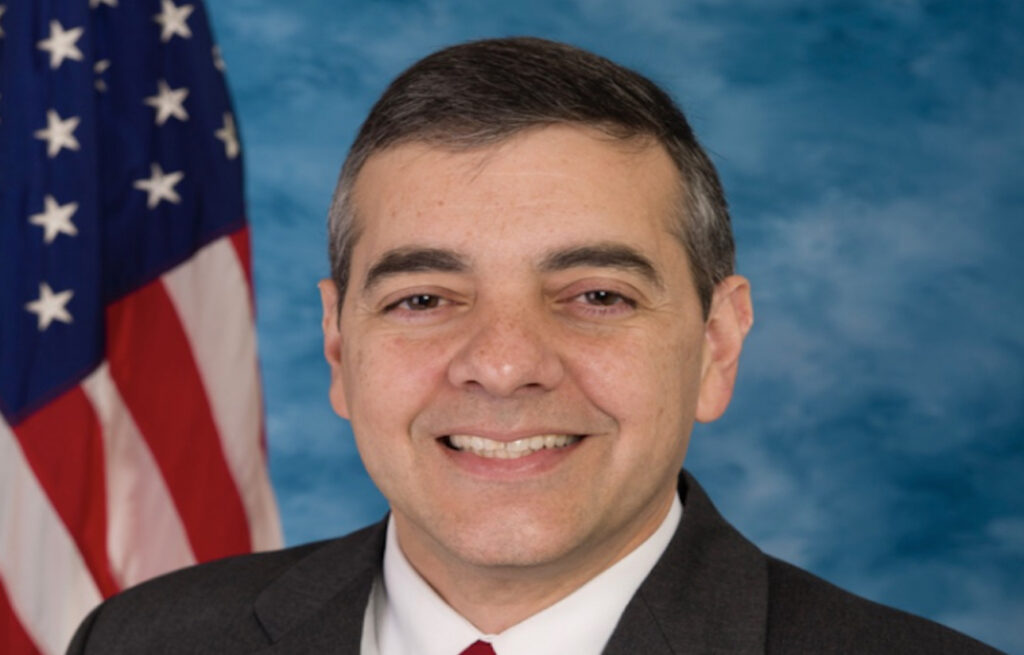
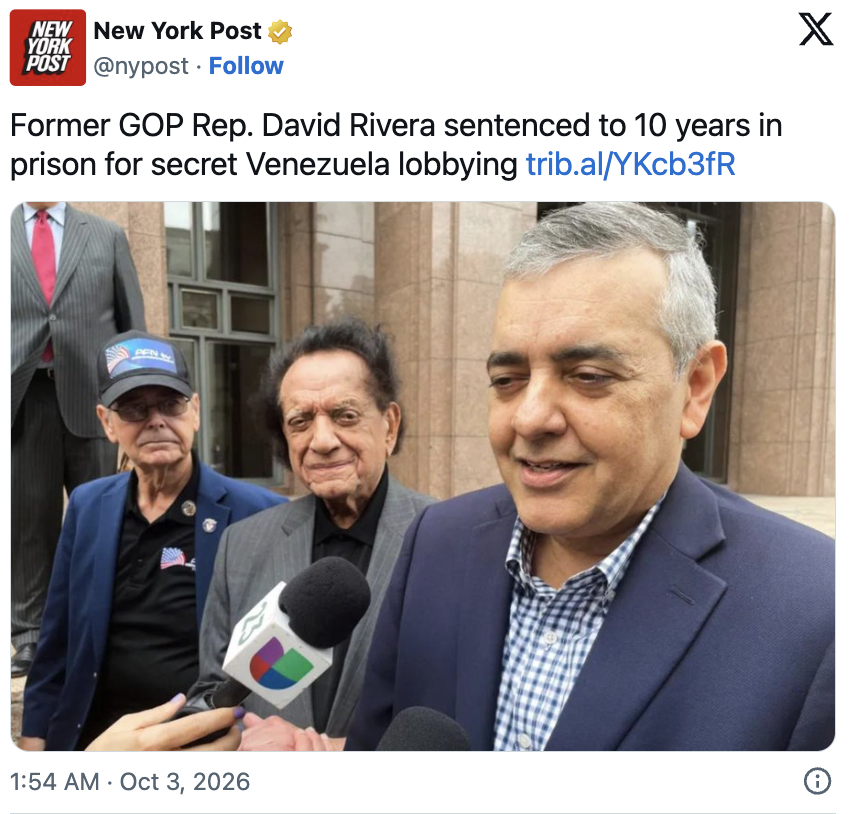
Former Republican Congressman David Rivera has been sentenced to 10 years in federal prison following his conviction on foreign-agent and money-laundering charges connected to Venezuela. U.S. District Judge Melissa Damian handed down the sentence Friday, imposing 120 months on five counts and 60 months on two additional counts.
The prison terms will run concurrently. Rivera was also ordered to serve one year of supervised release after leaving prison and pay a $700 mandatory special assessment. The judge did not impose a fine. The 61-year-old former Florida congressman has remained in custody since a federal jury convicted him in May 2026.
His co-defendant, political consultant Esther Nuhfer, was sentenced in August to five years in prison. Rivera’s attorneys have indicated that they plan to appeal the conviction. His legal team also submitted a request for a presidential pardon in June.
A separate case involving foreign lobbying allegations against Rivera remains pending in Washington, D.C. The federal prosecution centered on a consulting agreement signed in March 2017 between Rivera’s company, Interamerican Consulting, and PDV USA, a U.S. affiliate of Venezuela’s state-owned oil company, PDVSA.
The agreement was reportedly worth as much as $50 million for approximately three months of consulting work.
Federal prosecutors said Rivera’s company ultimately received $20 million through four separate $5 million payments.
Three of those payments reportedly came from PDV USA during March and April 2017.
A fourth payment allegedly came from PDVSA later that year through Russia’s Gazprom Bank.

Prosecutors argued that Rivera and Nuhfer used the consulting arrangement to conduct lobbying efforts involving American officials without properly registering under the Foreign Agents Registration Act.
According to the government, Venezuelan officials wanted help persuading members of the first Trump administration and Congress to ease sanctions and improve relations with the government of Nicolás Maduro.
Trial testimony included discussions of Rivera’s communications with then-Senator Marco Rubio and Republican Rep. Pete Sessions of Texas.
Rubio, who had a longstanding personal relationship with Rivera and previously lived with him, testified that he had not been informed about the oil-company consulting agreement.
Sessions similarly testified that he was unaware of the arrangement.
After a seven-week trial in Miami, the jury convicted Rivera and Nuhfer on all charges brought against them.
Those charges included conspiracy involving foreign-agent registration requirements, conspiracy to commit money laundering, and financial transactions involving proceeds prosecutors described as unlawful.
Federal prosecutors also accused the defendants of attempting to conceal their activities through backdated records and allegedly fraudulent consulting agreements.
The government said encrypted messages included code names referring to political officials and financial transactions.
Prosecutors argued that Rivera had an additional reason to hide the arrangement because it conflicted with his public reputation as a vocal opponent of the governments in Venezuela and Cuba.
Rivera’s attorneys offered a different explanation. The defense maintained that the consulting work was focused on commercial efforts to encourage ExxonMobil to return to Venezuela.
His lawyers argued that those activities generally fell outside the type of political lobbying that would have required foreign-agent registration.
The defense also maintained that Rivera’s conversations with U.S. officials were intended to encourage political change in Venezuela rather than strengthen Maduro’s government.
Attorneys further argued that the underlying activity itself was not inherently illegal and that any violation could have been avoided through proper registration paperwork. Judge Damian rejected those arguments during sentencing.
She concluded that the money ultimately came from the Maduro government and characterized the conduct as an effort motivated by financial gain while concealing important information from Rivera’s political associates.
Rivera previously served in the Florida House of Representatives from 2002 until 2010. He later represented Florida’s 25th Congressional District in the U.S. House from 2011 until 2013. His sentencing represents a dramatic turn for a former elected official who once held positions at both the state and federal levels of government.
Join the Conversation
Keep Reading


FBI Releases Chilling Texts of Would-Be Trump Assassin
Trump Hints at Fox News Star For Press Secretary



Rob Lowe’s Niece Dead at 13


Death Row Woman Survives Lethal Injection — Twice
Biden-Era Prosecutor Hit With Criminal Investigation Referral

Share your perspective and reply to other readers.
Free account required. You will stay on this page.