
CNN Issues Major Warning to Democrats Ahead of Midterms
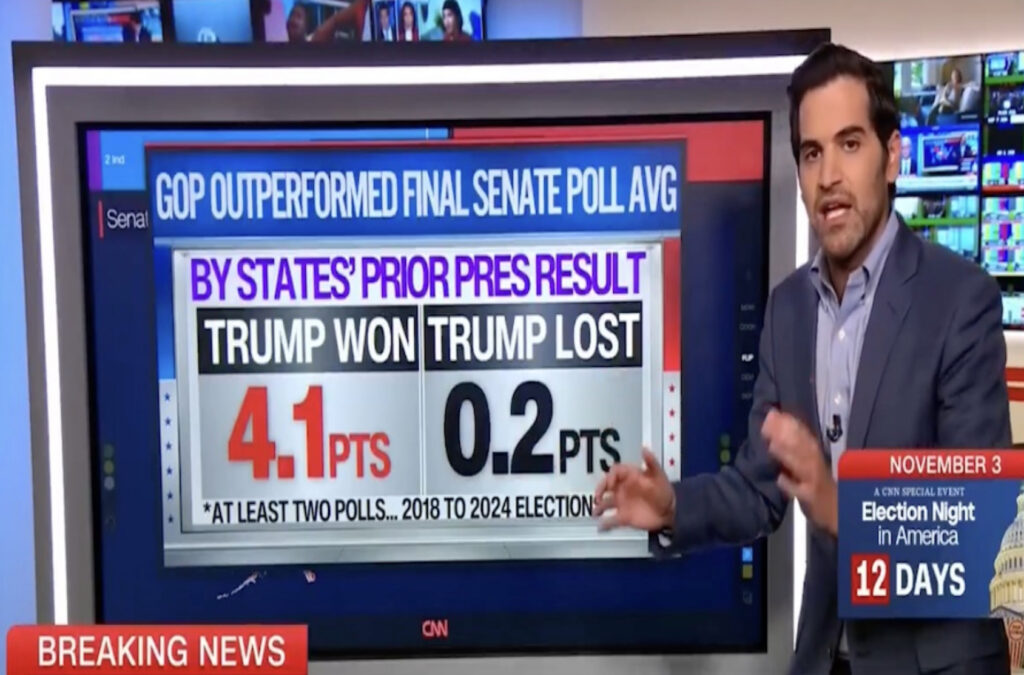
CNN chief data analyst Harry Enten delivered a significant warning to Democrats ahead of the 2026 midterm elections, pointing to historical polling inaccuracies that could dramatically alter the battle for control of the U.S. Senate. Although Democratic candidates currently hold narrow advantages in several competitive races, Enten explained that Republicans have repeatedly performed better on Election Day than surveys predicted, particularly in states carried by President Donald Trump.
During an appearance on CNN News Central, Enten examined the latest Senate polling averages alongside election results from previous cycles. His analysis revealed a consistent pattern of Republican candidates exceeding expectations in traditionally conservative states, raising questions about whether Democrats’ apparent advantages will translate into victories when voters cast their ballots in November.

The findings could have major implications for Senate control. Democrats are attempting to capture several seats in states Trump comfortably won during the 2024 presidential election, making their path to a majority particularly challenging if Republican voters once again outperform polling projections.
According to Enten’s analysis, Republican Senate candidates exceeded their final polling averages by approximately 4.1 percentage points in states Trump carried during recent election cycles. By comparison, Republicans outperformed expectations by just 0.2 points in states Trump lost.
The difference suggests that polling errors have been concentrated in Republican-leaning states rather than distributed evenly across the country.
Enten emphasized that this pattern has appeared in multiple elections, including 2018, 2020, 2022, and 2024. The repeated discrepancies could prove especially consequential in closely contested Senate races.
“There is reason to be cautious,” Enten said while discussing whether Democrats should trust their current polling advantages.
The CNN analyst also suggested that some Republican voters may not be adequately represented in public opinion surveys, potentially contributing to the differences between polling projections and actual election results.
Current polling nevertheless shows Democrats performing competitively in several states that favored Trump by substantial margins in 2024.

In Ohio, Democratic candidate Sherrod Brown holds an approximately four-point polling advantage, while Democrats lead by three points in Michigan, Texas, and Alaska, according to the averages examined during the segment.
Iowa presents another closely contested race, with Democrats holding a one-point advantage. Kansas, which has not elected a Democratic U.S. senator since 1932, is effectively tied in the polling averages.
Maine also remains competitive, with Democrats holding an approximately two-point advantage in the figures discussed.
Enten then considered what would happen if Republicans once again exceeded polling expectations by approximately 4.1 points in states Trump previously won.
Under that hypothetical scenario, Republican candidates would overcome Democratic polling advantages in several critical contests, including Ohio, Michigan, Texas, Alaska, and Iowa. Kansas would also shift from a statistical tie to a Republican advantage of roughly four points.
The resulting Senate map would leave Republicans controlling the chamber by a 52-48 margin, according to Enten’s calculations.
CNN: The GOP outperform senate polls in Trump states by an average of 4.1 points
If that counties
Ohio 🔵 Dem +4 -> 🔴 GOP +0.1
Michigan 🔵 Dem +3 -> 🔴 GOP +1
Alaska 🔵 Dem +3 -> 🔴 GOP +1
Texas 🔵 Dem +3 -> 🔴 GOP +1
Iowa 🔵 Dem +1 -> 🔴 GOP +3
Kansas 🟡 Tied -> 🔴 GOP +4 https://t.co/jfowTCbPI4— OSZ (@OpenSourceZone) October 23, 2026
That outcome would represent a major setback for Democrats, who are counting on victories in traditionally Republican states to secure a Senate majority. However, the projection is a historical comparison rather than a prediction that Republicans will necessarily outperform polls again.
Enten acknowledged that Democrats remain ahead in several important polling averages. If those numbers accurately reflect the final election results, Democrats could capture control of the Senate.
The CNN analyst ultimately stressed that the outcome depends on whether historical polling errors repeat themselves. With several competitive races separated by only a few percentage points, even a modest polling discrepancy could determine which party controls the Senate after November.
Join the Conversation
Keep Reading

FBI Arrests Georgia Man Accused of Terror Attack on ICE Facility


Ilhan Omar Deletes Old Tweet — But We Caught It
Trump Slams Judge in Charlie Kirk Murder Case



Legendary ‘Top Gun’ Actor Tom Skerritt Dead



Share your perspective and reply to other readers.
Free account required. You will stay on this page.