Shock 2028 Poll on Rubio And Vance
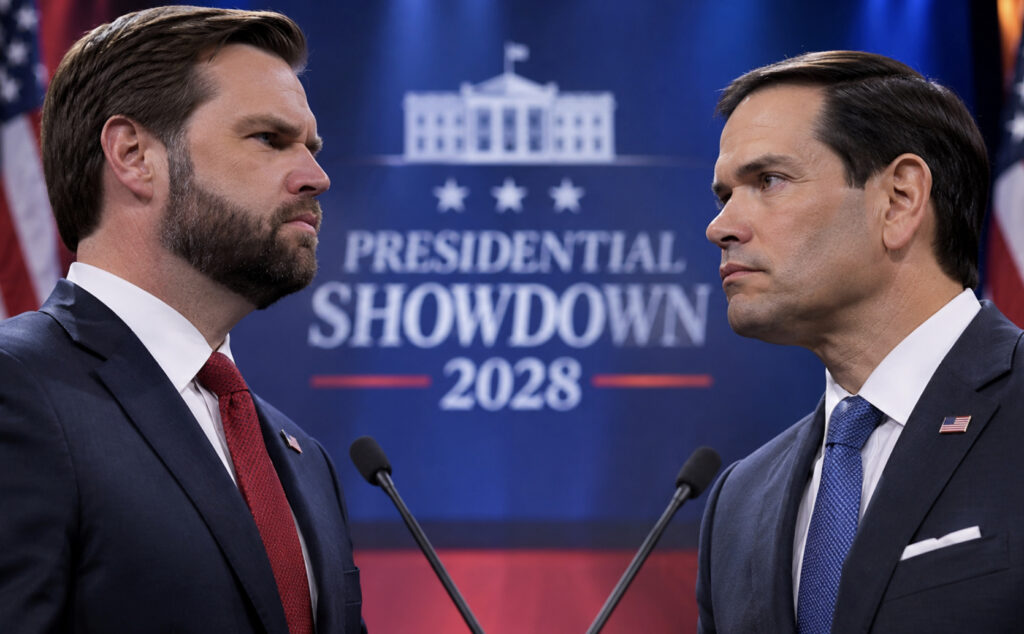
A new Emerson College national survey shows Secretary of State Marco Rubio leading Vice President JD Vance for the 2028 Republican presidential nomination. Rubio received 44 percent support among Republican primary respondents when given a list of candidates, compared with 24 percent for Vance. Florida Governor Ron DeSantis finished third at 9 percent, and Donald Trump Jr. received 6 percent. The 20-point gap represents an early but notable shift in the emerging field.
In an open-ended question without a candidate list, Rubio still led with 36 percent to Vance’s 20 percent. DeSantis, Trump Jr., and Rep. Thomas Massie each received 7 percent. Neither Rubio nor Vance has formally declared a 2028 candidacy. Rubio previously ran against Trump in the 2016 primary before becoming a key Cabinet official. His role as secretary of state has given him a high-profile platform on foreign policy. Vance has been viewed as a natural MAGA successor given his close ties to the president.
The survey also found broader challenges for the Republican Party. Only 35 percent of respondents held a favorable view of the GOP, while 56 percent viewed it unfavorably. Trump’s job approval stood at 37 percent approve and 54 percent disapprove. On the Democratic side, Georgia Sen. Jon Ossoff led with 17 percent, narrowly ahead of former Vice President Kamala Harris at 16 percent and Rep. Alexandria Ocasio-Cortez at 15 percent. Pete Buttigieg followed at 14 percent and California Gov. Gavin Newsom at 11 percent.
Economic concerns dominated voter priorities. Fifty-seven percent of respondents identified addressing the cost of living as a top issue for the next Congress. The Emerson poll was conducted November 14–16 among 1,000 registered voters. The overall credibility interval was roughly three percentage points, though the smaller primary samples carry greater uncertainty. The results offer an early snapshot rather than a firm prediction. The 2028 election remains two years away.
Rubio’s lead appears tied to his visibility on international issues. His position has placed him at the center of major diplomatic developments. Vance remains one of the party’s most recognizable younger figures and a frequent defender of the administration’s agenda. The poll suggests Rubio has established a substantial early advantage among those surveyed. Neither candidate has launched a formal campaign. The findings could influence how both men position themselves in the coming months.
The closed-ended and open-ended results both showed Rubio ahead by double digits. That consistency strengthens the early signal. DeSantis’s single-digit showing continues a decline from his 2024 primary performance. Trump Jr. received modest support as a potential heir. The broader party favorability numbers indicate ongoing challenges. Trump’s approval rating remains underwater in the survey. Those figures provide context for the primary contest. Republican voters appear to be looking beyond the current administration’s principals.
Ossoff’s narrow lead among Democrats reflects the early and fluid nature of that primary. Harris and Ocasio-Cortez remain competitive. Buttigieg and Newsom trail but stay in the conversation. The Democratic field is even less settled than the Republican one. Cost-of-living concerns cut across party lines. The Emerson sample included both partisan primary questions and general-population items. The timing, two years before the election, limits the predictive value. Early polls often shift as candidates formally enter.
Rubio’s 44-to-24 advantage over Vance is the headline number. The open-ended result of 36-to-20 reinforces the same ordering. Rubio’s prior 2016 experience and current Cabinet role give him a different profile than Vance. Vance’s vice-presidential position has traditionally been a strong launching pad. The poll suggests that advantage is not automatic in this cycle. Foreign-policy visibility may be helping Rubio. Domestic messaging remains central for Vance. Both men will face questions about their relationship to Trump as the race develops.
The survey’s credibility interval means the primary margins carry more uncertainty than the overall sample. Still, the double-digit gaps are large enough to register as meaningful early signals. Party favorability at 35 percent favorable is a notable weakness. Trump’s 37 percent approval provides additional context. Those numbers could affect how primary voters evaluate the field. Rubio and Vance both serve in the administration. Their relative standing may shift as policy outcomes become clearer. The poll captures a moment rather than a fixed hierarchy.
DeSantis’s 9 percent showing places him well behind the top two. Trump Jr.’s 6 percent indicates limited early traction. The open-ended results distributed support more widely but still favored Rubio. Massie’s 7 percent in the open-ended question reflects a smaller libertarian-leaning segment. The overall picture shows a clear top tier of two candidates. The remaining field is fragmented. Early positioning will matter as potential candidates decide whether to run. Rubio currently holds the stronger position in this survey.
The Democratic numbers show a crowded and unsettled field. Ossoff’s slight edge over Harris is within the range of sampling variation for the subgroup. Ocasio-Cortez’s 15 percent keeps her competitive. Buttigieg and Newsom remain relevant. The absence of a clear frontrunner is typical at this stage. Cost-of-living concerns are the dominant policy priority across the sample. Those concerns will shape both parties’ messaging. The Emerson poll provides one data point among many that will follow. The 2028 contest is only beginning to take shape.
Rubio’s lead is the most striking result. Vance’s second-place standing keeps him firmly in the conversation. Neither has declared. The survey’s timing and sample size limit firm conclusions. Party favorability and presidential approval numbers add context. Economic priorities cut across the electorate. The open-ended and closed-ended results tell a consistent story on the Republican side. Rubio holds an early advantage. The field remains open. Future polls will test whether the current ordering holds.
The Emerson findings place Rubio ahead of the sitting vice president by a clear margin. That outcome was not widely expected. Vance has been the presumptive MAGA heir in much of the commentary. The poll suggests voters are open to other options.
Rubio’s foreign-policy role may be a factor. Vance’s domestic profile remains strong. Both men will continue to serve in the administration. Their relative standing could change with events. The survey is an early indicator, not a prediction. The race is still forming.
Trump’s approval and the party’s favorability provide the broader backdrop. Both numbers are underwater in the survey. Those figures may influence primary dynamics. Cost-of-living concerns dominate the policy agenda. The Democratic side shows its own fluidity.
Ossoff leads a tightly bunched field. The overall picture is one of early uncertainty with a clear Republican ordering in this particular poll. Rubio currently holds the stronger position. Vance remains the main alternative. The contest will evolve.
The double-digit gap in both question formats is the central finding. Rubio leads Vance by 20 points in the closed-ended question and 16 points in the open-ended version. That consistency is notable. DeSantis and Trump Jr. trail well behind.
The broader political environment shows challenges for the party. Economic issues top the priority list.
The poll captures a moment two years before the election. Early advantages can shift. Rubio holds the current edge in this survey. The field is not settled.
Join the Conversation
Keep Reading
Democrat’s Criminal Case Takes MAJOR Turn
Netflix Actor Found Dead at 38
Trump’s Unprecedented Moment on World Stage
Next House Speaker Revealed
Paris Hilton Teams Up With AOC
Fox Host Reveals Why His Family Is Stockpiling Supplies
Gas Prices Crash to Low Point

Trump Announces Historic Breakthrough
Share your perspective and reply to other readers.
Free account required. You will stay on this page.