$1.7 Trillion Biden-Era Spending Bill Was Passed Unconstitutionally
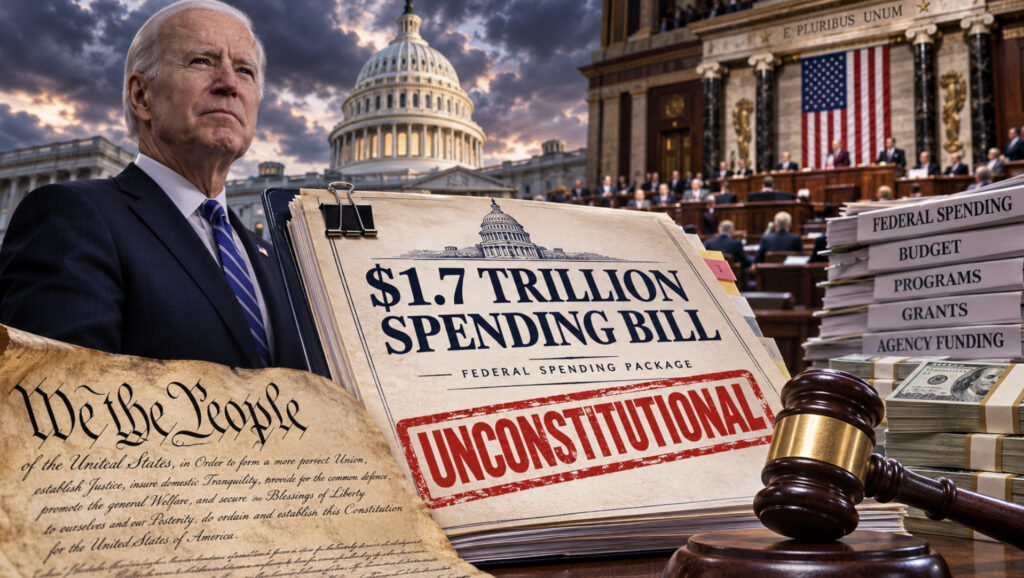
A federal appeals court ruled 9-8 that the Democratic-controlled House violated the Constitution when it passed a $1.7 trillion government spending package in December 2022 by counting proxy votes toward the required quorum. The full 5th U.S. Circuit Court of Appeals in New Orleans held that absent members voting by proxy cannot satisfy the constitutional requirement for a majority of members to be physically present.
U.S. Circuit Judge Cory Wilson, appointed by President Trump, wrote the majority opinion. The court determined that Article I, Section 5 requires a majority of House members to be present in person to establish a quorum. “Proxy presence” does not count.
“While the chambers of the legislature have much discretion regarding their rules of procedure, the Quorum Clause’s constraints on congressional power cannot be circumvented by congressional fiat,” the ruling stated.
The decision targets the Consolidated Appropriations Act of 2023, which passed the House 225-201 with 226 lawmakers voting by proxy. The legislation was signed by then-President Joe Biden.
The proxy-voting system was introduced under former Speaker Nancy Pelosi in May 2020 during the COVID-19 pandemic. Democrats defended it as necessary to keep Congress functioning; Republicans argued that lawmakers must appear in person for legislative business.
Republicans ended the practice after regaining the House in January 2023. The latest ruling stems from a 2023 lawsuit by Texas Attorney General Ken Paxton challenging the Pregnant Workers Fairness Act, a provision inside the larger spending bill.
A federal district judge blocked enforcement of that provision against Texas in 2024. A three-judge panel later reversed the decision, but the full 5th Circuit reinstated the injunction.
The majority found the House’s passage of the broader package unconstitutional yet limited the immediate remedy to barring enforcement of the Pregnant Workers Fairness Act against Texas. It did not strike down the entire $1.7 trillion law.
U.S. Circuit Judge James Graves, appointed by President Obama, dissented, calling the ruling “illogical, inexplicable, and invalid.” He argued the Constitution does not explicitly demand physical attendance and that Congress has wide authority over its procedures.
The decision could invite further challenges to other legislation passed under the same pandemic-era rules. The Justice Department had defended the law throughout the litigation.
Proxy voting allowed members to authorize colleagues to cast votes on their behalf when they could not attend. The practice continued after the initial emergency period, drawing sustained Republican objections.
The 5th Circuit’s narrow remedy leaves most of the spending package intact while blocking one specific provision in Texas. Additional lawsuits remain possible.
The ruling reaffirms the physical-presence requirement for a House quorum under the Constitution. It marks a significant legal setback for the proxy system first adopted in 2020.
Join the Conversation
Keep Reading


Meghan Markle’s Father Indicted


Judge Issues Major Ruling on 2020 Election


Trump Returns to Oval Office With Urgent Message for America


Ilhan Omar Investigation Takes Major Turn

Trump Unleashes on Gavin Newsom

Trump Announces Major Death Penalty Move

Share your perspective and reply to other readers.
Free account required. You will stay on this page.