
U.S. Army Detonates Lead-Based Chemical Depot in Iowa
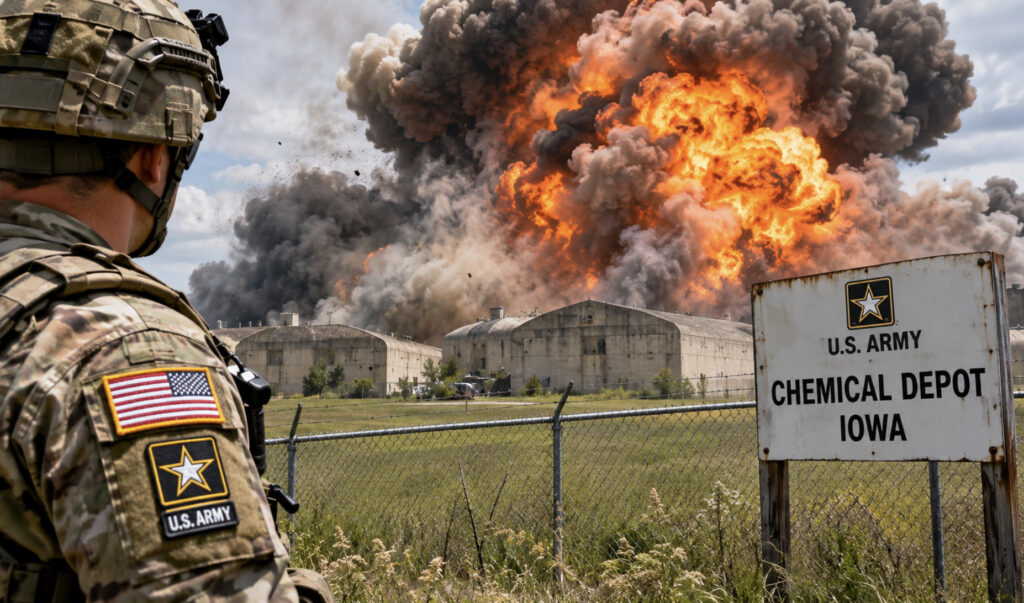
The U.S. Army carried out a controlled detonation of nearly 10,000 pounds of unstable explosive material at the Iowa Army Ammunition Plant in Middletown on Wednesday after a federal appeals court rejected a legal challenge seeking to halt the operation. Seconds after 10 a.m. ET, twin plumes rose into the air as the military destroyed almost five tons of lead azide, sending a shockwave across surrounding fields.
A local reporter on the air described the force of the blast. “Big boom right there. We can actually feel that percussion from that,” said Cyle Dickens of KWQC. “I could actually visibly see the shockwave coming through. We’re in a safe location.”
Acting Army Secretary Adam Telle said the controlled explosion was the safest option available for disposing of deteriorating lead azide, a highly sensitive compound used in detonators and blasting caps. Officials examined every alternative before concluding that an on-site detonation was necessary to prevent a spontaneous accident.
“We have talked to every expert within the federal government and every expert we could find outside the federal government,” Telle told reporters. “A controlled, mitigated detonation of the lead azide here at Iowa Army Ammunition Plant is far preferable to an uncontrolled spontaneous detonation of that substance.”
The operation involved 68 barrels containing more than 9,700 pounds of net explosive weight. The drums had degraded rapidly over the past eight months, leaving crystallized explosive material on exterior surfaces and lids, making movement or neutralization too dangerous.
Military specialists built an extensive system of protective barriers, including two-story sand-filled walls, eight water tanks holding 16,000 gallons each, gel blocks, misting equipment, and specialized firefighting foams free of PFAS chemicals. The goal was to contain the blast and limit the release of lead particles.
Scientists and environmental researchers moved quickly to place monitors and collect soil samples. Residents in Iowa and neighboring states expressed concern about possible lead contamination.
The EPA deployed 150 additional sampling teams across three states along with four mobile labs. Officials promised free testing for any home, business, or school that requested it.
A federal appeals court cleared the way for the detonation after legal challenges failed. Army leaders maintained that further delay would only increase the risk of an uncontrolled explosion.
Early reports indicated the mitigation measures performed better than expected. President Trump noted that the Army’s efforts had exceeded expectations.
Lead azide’s extreme sensitivity made conventional disposal methods unsafe once the containers began to fail. The plant remains a major site for producing and storing ammunition components.
Nearby residents were advised to follow local safety guidance and stay clear of the installation during the operation. Environmental monitoring continues after the blast.
The controlled detonation resolved an immediate hazard created by long-term storage of unstable materials. Federal agencies continue to track air and soil quality in the surrounding area.
Join the Conversation
Keep Reading


Meghan Markle’s Father Indicted


Judge Issues Major Ruling on 2020 Election


Trump Returns to Oval Office With Urgent Message for America


Ilhan Omar Investigation Takes Major Turn

Trump Unleashes on Gavin Newsom


Trump Announces Major Death Penalty Move

Share your perspective and reply to other readers.
Free account required. You will stay on this page.