New Poll Reveals Why Republicans Lost the Midterms
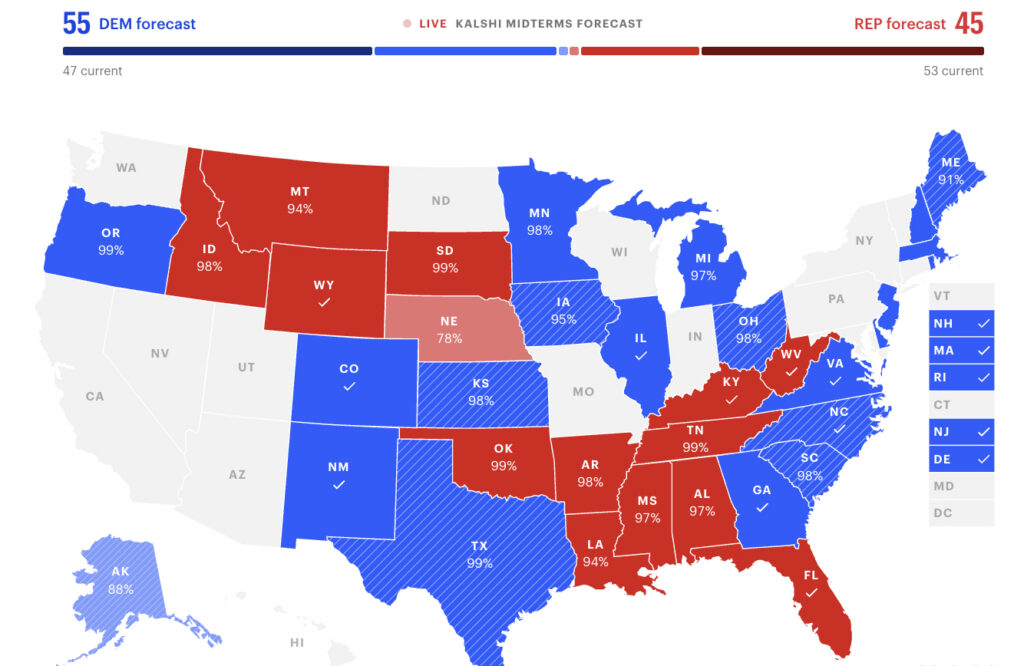
A J.L. Partners postmortem analysis of the 2026 midterms concludes that more than two-thirds of the Democratic “Blue Tsunami” stemmed from Trump 2024 voters simply staying home rather than switching parties.
The firm’s Election Day survey of 1,000 registered voters, cross-checked against more than 30,000 campaign interviews, found that 35 percent of Trump’s 2024 supporters did not cast a ballot on November 3, while only 8 percent crossed over to Democrats.
That non-voting bloc alone accounts for 10 points of the 15-point swing toward Democrats since 2024; the remaining five points came from the smaller group of defectors.
Founding director James Johnson stated, “Even without a single voter switching, the GOP would have lost the Senate and House. That is how important turnout was at this election.”
The steepest drop-offs occurred inside Trump’s core: 46 percent of his non-college voters, 44 percent of those over 65, and 39 percent of rural supporters sat out.
Johnson added that the GOP “should not throw the MAGA baby out with the bathwater just yet” and that re-energizing the 2024 electorate in 2028 could still produce a winning coalition.
The data bolsters Trump’s claim that Republicans lost because his name was absent from the ballot, even though he urged supporters to treat the midterms as if he were running.
The findings directly contradict Vice President JD Vance’s post-election assertion that “the main problem is not turnout” and that losses mainly reflected crossover voters.
Florida Governor Ron DeSantis separately argued on Fox News that many Republican voters stayed home out of frustration with limited productivity from the House and Senate.
Nearly half of Democratic voters (48 percent) described their midterm choice as a vote against Trump rather than an endorsement of specific party proposals.
Only 30 percent of registered voters believe Democrats have a candidate ready for the 2028 presidency, and 29 percent of Democratic voters themselves say no.
The 8 percent who switched were disproportionately younger, male, nonwhite, and urban—the same groups Trump had expanded in 2024—yet half still view the Republican Party favorably and 41 percent approve of Trump’s job performance.
Johnson theorized that some defectors treated a 2024 Trump vote as a “gateway drug” into the political process and have not drifted far.
Cost of living, including gas prices, ranked as the top issue across every demographic group measured, with the Iran war sitting underneath as a contributing factor even though only 3 percent named it first.
Johnson noted that voters in focus groups “know it’s because of the war” when explaining higher prices.
The firm’s projection that turnout alone would have given Democrats roughly 52 Senate seats is described as “relatively crude” because it applies the national figure uniformly to every state.
The overall margin of error is 3.4 points, rising to 10.5 among the small sample of 87 defectors.
Republicans therefore face a clear 2028 task of reactivating the non-voting portion of the 2024 coalition rather than solely chasing the smaller group of switchers.
Join the Conversation
Keep Reading



Hollywood Star Demands Democrats Abolish ICE


Country Music Legend Gets Major Apology



Share your perspective and reply to other readers.
Free account required. You will stay on this page.