Liberals Are SICK. Here’s Proof
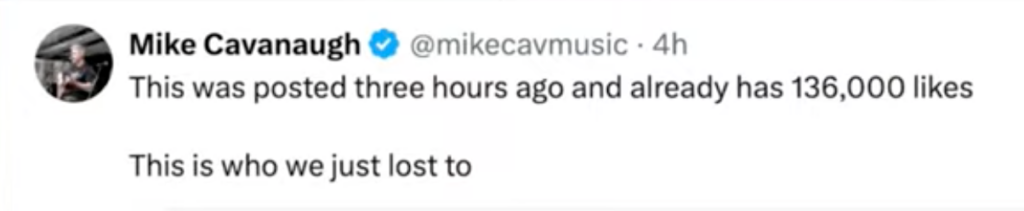
This tweet is absolutely disgusting. WATCH:
Background Info: The assassination of conservative activist Charlie Kirk returned to the center of political controversy during Tuesday’s midterm elections, as a disturbing social media post referencing his murder circulated online. The controversy unfolded alongside accusations that a Minnesota election worker had worn clothing mocking Kirk’s death, triggering outrage among conservative commentators and renewed debate over political violence in America.
On November 3, an X account operating under the name Dread Moroz, with the username @Dread_Botlord, published a provocative message about the slain conservative activist. The post declared, “we’re digging up Charlie Kirk and doing it again.” The statement appeared as Americans were casting ballots in consequential congressional and statewide elections, adding to concerns about increasingly hostile political rhetoric.
The message gained significant attention after verified X user Mike Cavanaugh shared a screenshot and criticized the post. Cavanaugh wrote, “This is who we just lost to,” apparently referencing Republican electoral setbacks. His screenshot showed approximately 1.6 million views on the original message, while Cavanaugh claimed it had accumulated 136,000 likes within three hours. Those engagement figures were displayed or reported in the screenshot and have not been independently verified.
The timing intensified the reaction. Kirk, a prominent conservative commentator and close ally of President Donald Trump, had been assassinated just over a year earlier. His killing became a defining moment in the national conversation about political violence, particularly because it occurred during a public event where he was engaging with college students about controversial political issues.
A separate controversy emerged in Rogers, Minnesota, where a photograph of an election worker wearing a white shirt with red splatter and the words “Problem Solved” spread across social media on Election Day. Conservative commentators accused the worker of referencing Kirk’s assassination, citing the resemblance between the shirt and images from the fatal shooting. However, city officials subsequently disputed that interpretation, explaining that the clothing was a Halloween costume without political intent.
The photograph was reportedly taken on Saturday, October 31, at a polling location inside the Rogers fire station community room, rather than on Election Day itself. The image nevertheless attracted widespread attention on November 3, prompting questions about appropriate conduct by election officials and whether voters might reasonably interpret the clothing as an offensive political statement.
Hennepin County officials initially referred the complaint to the Rogers city clerk for review. The City of Rogers later confirmed that it had spoken with the election worker, who denied making any political statement or reference to Kirk. Officials also disclosed, with the worker’s permission, that she was serving as a Republican election judge. The city said the shirt did not violate Minnesota’s statutory restrictions on political messaging at polling places, although it would have requested that she remove or cover the clothing had officials recognized the possible interpretation.
Despite that explanation, the incident demonstrated how deeply Kirk’s assassination continues to influence political conversations. The photograph generated accusations of insensitivity and political intimidation, while the accompanying social media posts raised broader questions about how quickly unverified allegations can circulate during elections. The separate message about killing Kirk again added to the controversy, although there is no established connection between the anonymous account and the Minnesota election worker.
Kirk was fatally shot on September 10, 2025, while addressing thousands of attendees at Utah Valley University in Orem, Utah. The 31-year-old founder of Turning Point USA was participating in an outdoor event when a gunman opened fire, striking him in the neck. Emergency responders transported him to a hospital, where he was pronounced dead. The assassination shocked supporters and political figures across the country.
Investigators subsequently identified Tyler Robinson, a Utah resident who was 22 at the time of the shooting, as the suspect. Authorities accused Robinson of firing from an elevated position near the university event before fleeing. The investigation involved surveillance footage, physical evidence, witness testimony and electronic communications that prosecutors said connected Robinson to the killing.
Robinson faces multiple criminal charges, including aggravated murder. In September 2026, Utah District Judge Tony Graf determined that prosecutors had presented sufficient evidence for the case to proceed to trial. Robinson entered a not-guilty plea through his attorneys, and prosecutors have indicated that they intend to seek the death penalty if he is convicted. The criminal proceedings remain an important part of Kirk’s legacy and the continuing public response to his assassination.
Prosecutors have argued that Kirk was targeted because of his political beliefs, pointing to evidence recovered during the investigation and communications allegedly involving Robinson. Defense attorneys have challenged aspects of the prosecution’s account, including arguments supporting a potential death sentence. Although the case has advanced toward trial, the allegations against Robinson have not been resolved by a criminal conviction.
Before his death, Kirk had become one of the most recognizable voices in conservative politics. He founded Turning Point USA in 2012 and built the organization into a national movement focused on mobilizing younger Americans, particularly college students. Through campus appearances, debates, conferences and online broadcasts, Kirk developed a substantial following while promoting conservative positions on immigration, religion, education and government policy.
Kirk also maintained a close relationship with Trump and played a prominent role in efforts to increase Republican participation among younger voters. Turning Point’s broader political network emphasized voter registration, grassroots organizing and turnout operations. That history made Kirk especially relevant to the 2026 midterms, the first federal general election held after his assassination.
Tuesday’s elections were widely viewed as a major test of Trump’s second administration, with control of Congress and numerous governorships at stake. Republican and Democratic candidates competed in closely watched races across the country, while voters weighed issues ranging from economic conditions and immigration enforcement to public safety and the direction of federal policy. The results carried significant consequences for the administration’s legislative agenda during the remainder of Trump’s term.
For Kirk’s supporters, the midterms also represented an opportunity to continue the political movement he helped build. His emphasis on activating young conservative voters remained relevant to Republican efforts to maintain influence in Washington and compete in closely divided states. The circulation of hostile messages about his death on Election Night consequently struck a particularly sensitive nerve among those who regarded him as an influential figure in the conservative movement.
The controversies also highlighted the distinction between offensive political expression and actual threats of violence. The online message referencing Kirk’s murder was alarming in its language, but the available evidence does not establish that its author intended or was capable of carrying out an attack. Likewise, the allegations involving the Minnesota election worker were contradicted by the local government’s investigation and the worker’s explanation.
More than a year after Kirk’s assassination, his death remains a flashpoint in American politics. The combination of an inflammatory viral message, disputed accusations involving an election worker and a contentious midterm election illustrated the enduring tensions surrounding political violence and public discourse. As Republicans and Democrats assess the election results, the latest controversy underscores how Kirk’s killing continues to shape political debate long after his death.
Join the Conversation
Keep Reading
DC Shooter Identified — It’s Deeply Disturbing
Country Music Legend SNUBBED — Stars Erupt
Trump Administration Issues CHILLING Warning to Democrats
Former Obama CIA Director’s Son ARRESTED
Country Music Legend Given Just 1% Chance to Survive
Mike Pence Drops 2028 Bombshell
Share your perspective and reply to other readers.
Free account required. You will stay on this page.