
Trump’s AG SCHOOLS Fake News on Election Integrity
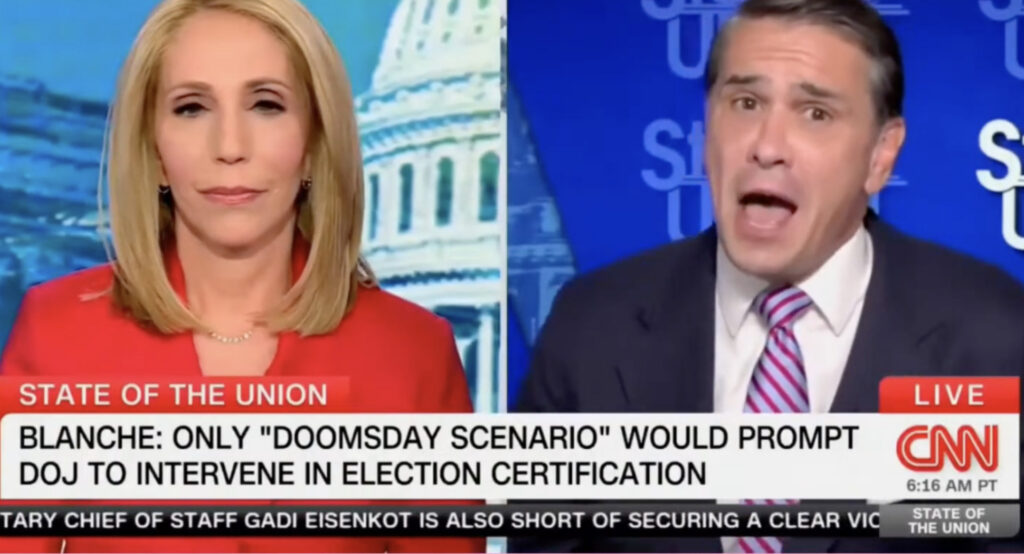
These fake news losers weren’t ready for Todd Blanche. WATCH:
Background info: Attorney General Todd Blanche engaged in a heated confrontation with CNN anchor Dana Bash on Sunday, October 25, defending the Trump administration’s efforts to protect election integrity ahead of the November 3 midterm elections. Appearing on CNN’s “State of the Union,” Blanche challenged the network’s presentation of constitutional law and rejected suggestions that President Donald Trump was preparing to interfere with election results.
The tense interview focused on a Justice Department lawsuit involving Alaska’s closely contested U.S. Senate race. Republican incumbent Dan Sullivan is facing Democrat Mary Peltola, but another candidate with a nearly identical name has complicated the contest. Blanche argued that the situation raises serious concerns about voter confusion, while Bash repeatedly questioned whether the administration was exceeding its constitutional authority.
The controversy involves Daniel J. Sullivan Jr., a Republican candidate whose name closely resembles that of the incumbent senator. Trump and other Republicans have accused the challenger of attempting to divert votes from the sitting senator. Daniel J. Sullivan Jr. has denied accusations that his candidacy is intended to mislead voters.
The Alaska Supreme Court ruled in June that the second Sullivan could remain on the ballot. Nevertheless, the Justice Department filed a federal lawsuit on October 23, arguing that potential voter confusion could undermine the accuracy of the election results.
During Sunday’s interview, Bash referenced Article I, Section 4 of the U.S. Constitution, emphasizing that states have primary responsibility for administering congressional elections. Blanche immediately challenged her presentation, pointing out that the constitutional provision also grants Congress authority to establish or modify election regulations.
Blanche demanded that CNN display the remainder of the constitutional language, arguing that Bash had emphasized only the portion supporting her argument. He maintained that Congress had already exercised its authority by passing federal election laws that the Justice Department was seeking to enforce.
The attorney general specifically referenced the National Voter Registration Act, which the administration is relying upon in its legal challenge. Blanche argued that the federal government has an obligation to protect voters when election procedures potentially interfere with their ability to cast meaningful ballots.
Bash countered that Alaska’s courts had already addressed the dispute and permitted the challenger to remain on the ballot. She also cited Republican Sen. Lisa Murkowski, who criticized the Justice Department’s lawsuit and argued that Alaska had taken sufficient steps to distinguish the candidates.
Blanche responded that the state court’s decision did not resolve the federal legal questions raised by the administration. He insisted that the lawsuit was designed to preserve the ability of Alaska officials and courts to investigate possible voter confusion if the election’s outcome became disputed.
The disagreement intensified when Bash asked how election officials could determine whether voters had mistakenly selected the wrong Sullivan. Blanche pointed to Alaska’s ranked-choice voting system, explaining that the way voters rank multiple candidates could potentially provide evidence of confusion.
The attorney general also rejected the suggestion that federal officials wanted to determine the winner of the Senate contest. He maintained that Alaska’s election authorities would remain responsible for reviewing ballots and resolving disputes, subject to applicable law and judicial decisions.
Bash subsequently questioned whether Trump had personally directed the Justice Department to file the lawsuit. The president had publicly acknowledged encouraging legal action, but Blanche declined to discuss private communications with Trump. He instead emphasized that Justice Department attorneys had independently examined the relevant federal statutes.
The exchange became particularly contentious when Bash suggested that the administration’s actions could establish a precedent for challenging unfavorable election outcomes. She raised concerns about a hypothetical post-election crisis and referenced the events surrounding January 6, 2021.
Blanche sharply rejected the comparison, arguing that Bash was conflating a specific dispute over Alaska’s ballot with speculation about a broader effort to overturn election results. He accused the network of shifting attention away from the underlying election-integrity concerns and toward an unsupported hypothetical scenario.
The dispute also revisited Blanche’s earlier comments about a potential doomsday scenario in which the Justice Department might become involved in election certification. Blanche maintained that those remarks described extraordinary hypothetical circumstances rather than an administration plan to challenge legitimate election outcomes.
At the center of the legal dispute is the Justice Department’s request to prevent certification of an election result if voter confusion is found to have materially affected the outcome. Critics, including voting-rights organizations and Peltola’s campaign, contend that the lawsuit represents an improper federal intervention in a state election. The American Civil Liberties Union has also challenged the administration’s interpretation of the voter-registration law.
The controversy carries significant political implications because Republicans are attempting to retain control of Congress in the upcoming midterms. Alaska’s Senate race has attracted increased attention as Peltola challenges Sullivan, and any dispute over the final results could become a major national political issue.
Blanche ended the confrontation by defending the administration’s intentions and insisting that the Justice Department was acting within its lawful responsibilities. Although the CNN exchange highlighted deep disagreements over federal election authority, the ultimate legality of the administration’s Alaska lawsuit remains a question for the courts as Election Day approaches.
Join the Conversation
Keep Reading
Democratic Party Leader Self-Deports
Jennifer Lopez Makes Stunning Hollywood Claim

Gavin Newsom Hit With Major Lawsuit
Trump Issues Chilling Warning to Iran

FBI’s Most Wanted Cartel Leader Captured
Melania Trump Makes Emotional Public Statement
Share your perspective and reply to other readers.
Free account required. You will stay on this page.