
Democrat Show Their True Colors on the Ten Commandments
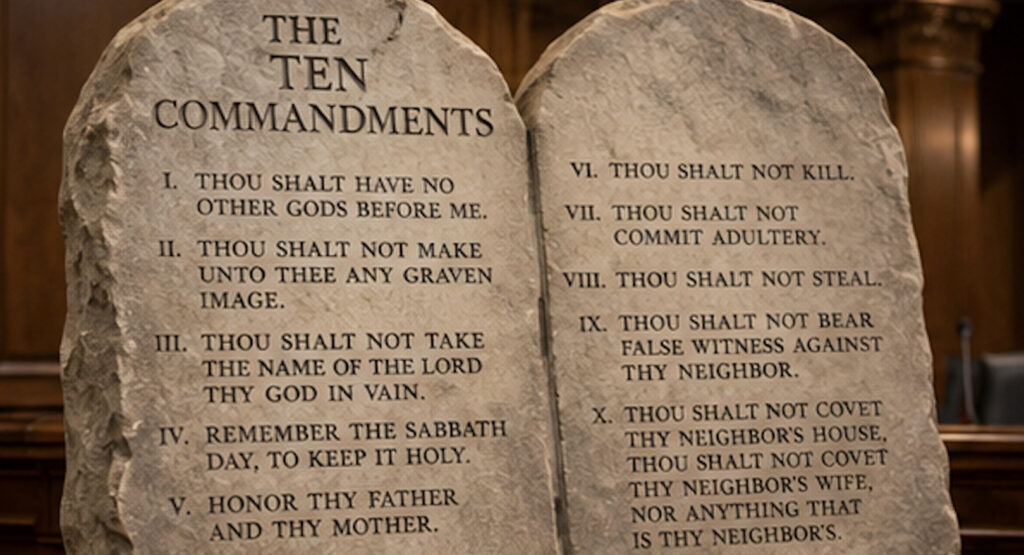
Texas Attorney General-elect Nathan Johnson announced this week that he will not defend a state law requiring public schools to display the Ten Commandments. The first Democrat elected to the office in nearly three decades called the statute unconstitutional and made clear he will reverse the state’s previous legal position.
In an interview with The Dallas Morning News, Johnson said his jurisprudential view is that the law violates the Constitution. “The court will have the ultimate say as to what’s constitutional and what is not, but I’m the one who says what the state’s position is, and it will not be the position the state has previously taken,” he stated.
The law, known as Senate Bill 10, mandates that a conspicuous copy of the Ten Commandments appear in every classroom of every public school and open-enrollment charter school in Texas. Outgoing Republican Attorney General Ken Paxton strongly supported the measure and has defended it in court.
In April the 5th U.S. Circuit Court of Appeals upheld the law, ruling that it did not violate the Constitution. Religious freedom advocates hailed the decision as recognition of the biblical text’s place in America’s legal and historical tradition.
The case could still reach the U.S. Supreme Court. Paxton’s office has already used Johnson’s stated opposition as part of its strategy, arguing in a recent filing that the incoming attorney general may not adequately defend the law and that the justices should therefore decline to hear the challenge.
If the Supreme Court refuses to take the case, the appeals court ruling will stand and the law will remain in effect. That outcome would preserve a legal victory for Paxton before he leaves office in January.
Johnson’s refusal sets up an early political confrontation with the Republican-controlled Legislature that passed the measure. His election was part of a broader Democratic wave that also included wins in the U.S. Senate and gubernatorial races in Texas.
Supporters of the law argue the Ten Commandments form a foundational element of Western legal tradition and American civic education. Opponents contend that mandatory classroom displays amount to government endorsement of religion.
The incoming attorney general’s decision means the state will no longer actively argue for the law’s constitutionality at the highest level. Lower-court precedents may still govern until a higher court intervenes.
Paxton’s team has portrayed Johnson’s stance as a reason the Supreme Court should avoid the case entirely. The filing contends that without a vigorous defense the justices would lack a true adversarial presentation.
Johnson has given no indication he will seek to repeal or ignore the statute through other means. His focus remains on declining to defend it in ongoing litigation.
The law’s fate now rests largely with the Supreme Court’s decision on whether to grant review. A denial would leave the 5th Circuit ruling intact across Texas.
Classroom displays have already begun in many districts under the current legal framework. School officials continue to implement the requirement while the higher-court process plays out.
Religious liberty groups continue to monitor the situation closely. They view the appellate victory as an important precedent that should not be abandoned.
Johnson’s position marks a clear break from the approach taken by his Republican predecessor. The change in legal strategy is expected to become one of the first tests of his tenure.
The debate over the Ten Commandments in public schools remains unresolved at the national level. Texas has become the latest flashpoint in that long-running conflict.
Join the Conversation
Keep Reading

AOC Reveals Big 2028 News



ICE Agent Faces Six Years in Prison


Trump Doubles Down Despite Midterm Losses

Bill Maher Declares Late-Night Comedy ‘Dead’

Two American Airlines Planes Collide

Supreme Court Takes Up Major 2nd Amendment Case



Share your perspective and reply to other readers.
Free account required. You will stay on this page.