
This Tweet PERFECTLY Explains International Relations
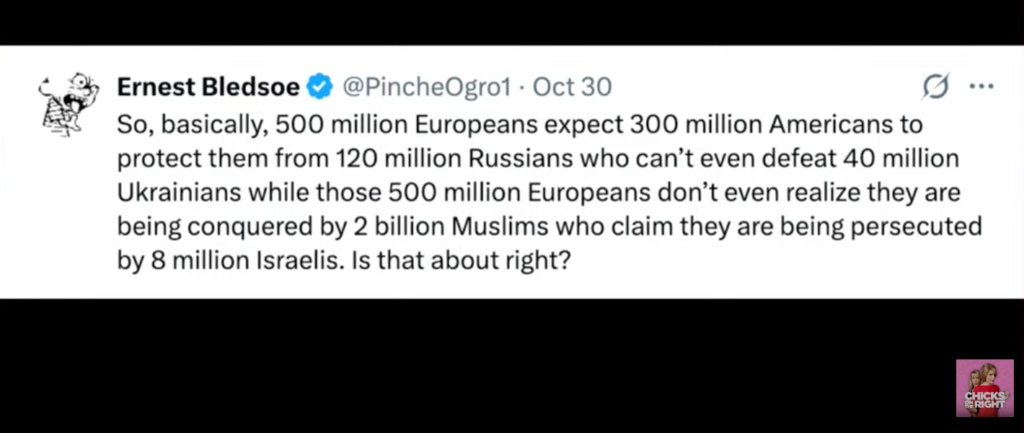
This is actual perfection. WATCH:
Background Info: A social media post examining the relationship between the United States, Europe, Russia, Ukraine, and the Muslim world has drawn attention for its provocative summary of modern international relations. The post, attributed to X user Ernest Bledsoe, uses a series of population comparisons to question America’s military commitments, Europe’s dependence on Washington, and the political and demographic challenges facing Western nations.
The October 30 post begins by suggesting that approximately 500 million Europeans expect 300 million Americans to defend them against 120 million Russians, despite Russia’s difficulty defeating a Ukrainian population of roughly 40 million. It then shifts to concerns about Islamic influence in Europe and tensions involving Israel, presenting several complicated geopolitical issues through a single rhetorical question.
Although the numbers are rounded and some of the conclusions are highly debatable, the post raises questions that have become increasingly prominent in American politics: How much responsibility should the United States assume for European security? Why do wealthy European nations continue to depend on American military capabilities? And how should Western governments respond to changing demographics, immigration pressures, and international conflicts?
At the center of the argument is the North Atlantic Treaty Organization, commonly known as NATO. Established in 1949, the alliance was designed to provide collective security against potential aggression, particularly from the Soviet Union. Its central principle, outlined in Article 5, treats an armed attack against one member as an attack against the alliance, although each country determines what assistance it considers necessary.
For decades, the United States has supplied a substantial portion of NATO’s military capabilities, including nuclear deterrence, intelligence systems, logistics, advanced weapons, and personnel. This arrangement has allowed European governments to benefit from American military strength while allocating varying portions of their national budgets toward domestic priorities.
President Donald Trump has repeatedly criticized this imbalance, arguing that European allies should assume greater responsibility for their own defense. His position reflects a longstanding concern among American policymakers that NATO’s wealthiest members have sometimes relied too heavily on Washington to guarantee their security.
However, European defense spending has increased substantially in recent years. NATO reported that European allies and Canada increased military expenditures by approximately 20 percent in 2025 compared with the previous year. All alliance members met or exceeded NATO’s former defense-spending benchmark of 2 percent of gross domestic product, demonstrating a significant shift in European military priorities.
The alliance has also adopted a more ambitious commitment to allocate 5 percent of GDP toward defense and related security expenditures by 2035. While implementing these plans will require considerable investment and political cooperation, the commitments reflect growing recognition that Europe must strengthen its military capabilities amid uncertainty about future threats.
Russia’s war against Ukraine provides another important dimension to the discussion. When Moscow launched its full-scale invasion in February 2022, Russian leaders anticipated a campaign that would establish control over Ukraine far more quickly than events ultimately allowed. Instead, Ukrainian resistance, Western military assistance, and Russian operational failures contributed to a prolonged and extraordinarily destructive conflict.
The war has demonstrated that population size alone does not determine military success. Ukraine’s ability to resist Russian forces has depended on numerous factors, including defensive advantages, battlefield intelligence, military leadership, international assistance, technological adaptation, and the willingness of Ukrainian forces to sustain prolonged combat operations.
Nevertheless, Russia’s struggles in Ukraine do not necessarily establish that it would be incapable of threatening other European countries. Military analysts distinguish between conquering and occupying a large nation, conducting limited attacks against neighboring states, launching cyber operations, and using nuclear weapons to intimidate opponents. Russia retains significant military capabilities despite the enormous costs of the war.
The strategic importance of American involvement also extends beyond defending European territory. NATO provides Washington with military bases, intelligence-sharing partnerships, logistical infrastructure, and diplomatic influence. Supporters of the alliance argue that these advantages help the United States project power internationally and deter conflicts before they require direct American intervention.
Critics counter that maintaining extensive overseas commitments can place unnecessary financial and military burdens on American taxpayers. They argue that European countries collectively possess the population, wealth, industrial capacity, and technological resources needed to establish a substantially more independent defense system. From this perspective, a stronger European military would allow Washington to devote additional attention to domestic priorities and strategic competition with China.
The social media post also introduces the controversial subject of Europe’s changing religious and demographic composition. Immigration from Muslim-majority countries has contributed to political debates across Europe concerning national identity, cultural integration, border security, religious freedom, and the responsibilities of governments toward refugees and migrants.
Research from the Pew Research Center estimated that Muslims represented approximately 4.9 percent of the population across 30 European countries in 2016. Depending on future migration patterns and demographic trends, researchers projected that this proportion could increase significantly by 2050. Those projections demonstrate demographic change, but they do not establish the post’s suggestion that Europe is being conquered by Muslims worldwide.
The distinction is important because the global Muslim population is spread across numerous countries, cultures, and political systems. Muslims do not constitute a unified political or military organization, and most live outside Europe. Legitimate debates about immigration levels, integration policies, extremism, and national sovereignty therefore require more specific evidence than comparisons between entire religious populations.
The post’s reference to Israel introduces another complicated geopolitical issue. Israel has a comparatively small population but possesses advanced military capabilities and maintains an extensive security relationship with the United States. Its conflicts with Hamas, Hezbollah, Iran, and other regional adversaries involve territorial disputes, terrorism, security concerns, religious tensions, and competing national aspirations. Reducing those conflicts to a numerical comparison between Israelis and Muslims overlooks the substantial political and historical differences among the parties involved.
Ultimately, the post’s appeal lies in its ability to compress several major international controversies into a memorable statement. Its population comparisons invite Americans to reconsider the distribution of military responsibilities and the assumptions underlying Western foreign policy, even as its more sweeping assertions require scrutiny. The broader question remains whether the United States and its allies can establish a more sustainable security arrangement while addressing immigration, national sovereignty, regional instability, and competing strategic interests in an increasingly unpredictable world.
Join the Conversation
Keep Reading

Democratic Party Leader Self-Deports

Jennifer Lopez Makes Stunning Hollywood Claim

Gavin Newsom Hit With Major Lawsuit
Trump Issues Chilling Warning to Iran


FBI’s Most Wanted Cartel Leader Captured
Melania Trump Makes Emotional Public Statement
Share your perspective and reply to other readers.
Free account required. You will stay on this page.