
Our Elections Are NOT Secure!
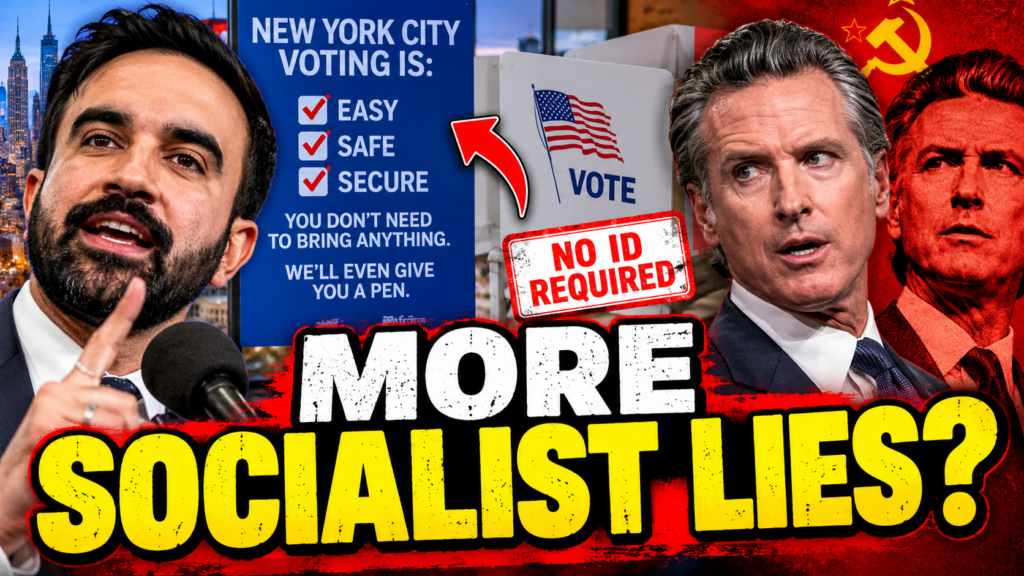
These idiots are proving we cannot trust them to secure the vote. WATCH:
Background Info: Republicans across the United States are continuing their push for stronger voter identification requirements, arguing that Americans should be required to prove their identity before casting a ballot in federal and state elections. Supporters believe voter ID laws represent a straightforward way to strengthen election security, prevent potential fraud, and increase public confidence in election results. The issue has become a major priority for President Donald Trump and Republican lawmakers as the country approaches the November 2026 midterm elections.
At the center of the Republican argument is the belief that voting is one of the most important responsibilities in American democracy and should be protected by meaningful identification requirements. Republicans frequently point out that identification is already necessary for numerous everyday activities, including boarding commercial flights, opening certain financial accounts, and completing government transactions. They argue that verifying a person’s identity before allowing that individual to vote is a reasonable safeguard for an activity that determines the country’s political leadership.
One of the most significant arguments in favor of voter ID is its potential to prevent voter impersonation. Under a photo identification requirement, an individual attempting to vote under another registered voter’s name would face an additional obstacle. Supporters contend that requiring identification provides election officials with a practical method of confirming that the person appearing at a polling location is the registered voter entitled to receive a ballot.
Republicans also argue that voter identification requirements can strengthen public confidence in election results. Even when allegations of widespread fraud are not substantiated, questions about election security can undermine trust in government institutions. Supporters believe that establishing consistent identity verification procedures could reassure voters that reasonable precautions are being taken to protect legitimate ballots and discourage illegal voting.
The issue has attracted substantial support beyond Republican voters. An August 2025 survey conducted by the Pew Research Center found that 83% of American adults favored requiring voters to show government-issued photo identification before voting. That included approximately 95% of Republicans and 71% of Democrats. Supporters frequently cite these findings as evidence that voter ID is a broadly popular election security measure rather than an issue supported exclusively by one political party.
President Trump has made stricter election identification requirements a central component of his election reform agenda. His administration has supported the Safeguard American Voter Eligibility Act, commonly known as the SAVE America Act, which would establish additional federal requirements for proving citizenship during voter registration and presenting photo identification when voting. Republicans argue that the legislation would create stronger nationwide safeguards and reduce differences between state election procedures.
In February 2026, the Republican-controlled House of Representatives passed the SAVE America Act by a vote of 218-213, with one Democrat joining Republicans in support. The legislation subsequently encountered obstacles in the Senate, where Republicans lacked the votes necessary to overcome procedural opposition. House Republicans continued urging Senate leaders to advance the measure, arguing that election security should remain a priority ahead of the midterm elections.
Republican Representative Chip Roy of Texas, a leading advocate of the legislation, has emphasized that election security should begin with confirming that voters are legally eligible to participate. His argument reflects a broader Republican position that citizenship verification and voter identification serve related but distinct purposes. Citizenship documentation helps determine eligibility during registration, while photo identification helps verify a voter’s identity when a ballot is cast.
Supporters of stronger voter ID requirements also point to documented instances of election fraud in several states. Although investigations have not established widespread in-person voter impersonation in recent national elections, individual cases demonstrate that violations can occur. Republicans argue that election security laws should address identifiable vulnerabilities before they develop into larger problems, particularly because relatively small numbers of improperly cast ballots could matter in extremely close contests.
In Texas, for example, a man named Manuel Rodriguez III was convicted after impersonating his elderly grandfather to vote in the 2014 general election while he was on supervised parole for a felony. According to the Heritage Foundation’s election fraud database, Rodriguez pleaded guilty to illegal voting charges and received a prison sentence. The case is an example of the type of in-person impersonation that photo identification requirements are specifically designed to deter.
North Carolina experienced a separate election fraud controversy following the 2018 congressional election in the state’s 9th District. Investigators uncovered an absentee ballot operation connected to political operative Leslie McCrae Dowless, involving improper ballot collection and other irregularities. The state ultimately ordered a new election. Although traditional polling-place photo ID requirements would not directly prevent that particular form of absentee ballot misconduct, Republicans point to the episode as evidence that election procedures require multiple layers of security.
Wisconsin has also experienced documented election-related misconduct. Kimberly Zapata, a former Milwaukee election official, was convicted in 2024 after requesting military absentee ballots using fictitious names and directing them to a state lawmaker’s address during the 2022 election. The case did not establish that fraudulent votes were successfully counted, but it demonstrated how election procedures could be misused. Supporters of election reform argue that identity verification, ballot tracking, and administrative oversight should work together to prevent similar incidents.
Georgia has emerged as one of the states Republicans frequently highlight when discussing election security improvements. The state requires identification for in-person voting and uses identity verification procedures for absentee ballots. Following changes enacted in 2021, Georgia also reported substantial voter participation in subsequent elections. State officials have emphasized that strengthening election safeguards and maintaining high voter turnout are compatible goals.
Georgia Secretary of State Brad Raffensperger has also promoted improvements in voter registration accuracy and election auditing. In September 2026, his office highlighted an independent review of the state’s voter list maintenance procedures, reporting that 99.8% of nearly 7.9 million voter registrations were associated with Georgia REAL ID records. Supporters cite these administrative improvements as examples of how states can strengthen identity verification systems while continuing to process millions of legitimate votes.
North Carolina has also made progress in implementing photo identification requirements. The state’s voter ID rules took effect for elections in 2023, and election officials have established procedures allowing voters to use several forms of acceptable identification, including certain government, student, and employee IDs. The state also provides identification exception procedures for eligible voters who cannot present an approved document. Republicans argue that such systems demonstrate how security requirements can be combined with alternatives intended to protect access for legitimate voters.
Other states have continued strengthening their election identification laws. West Virginia enacted legislation in 2025 establishing a photo identification requirement, while Louisiana approved stricter procedures scheduled to take effect in 2027. Arizona, Ohio, and Oklahoma have also pursued proposals to place identification requirements into their state constitutions. These developments reflect an expanding effort among Republican lawmakers to make voter verification a more permanent feature of state election systems.
Another benefit frequently emphasized by Republicans is the potential for voter ID requirements to create clearer and more consistent expectations for election administrators. Poll workers who are required to verify identification can follow established procedures instead of relying solely on a voter’s stated name or address. Supporters believe that consistent rules, clear training, accessible identification options, and properly documented exceptions can reduce opportunities for impersonation while making election administration more transparent and predictable.
For Republicans, the continuing debate over voter identification ultimately centers on protecting the legitimacy of American elections. They argue that requiring voters to establish their identity, maintaining accurate registration records, and strengthening ballot security can help preserve confidence that every lawful vote is counted properly. While voter ID alone cannot prevent every type of election fraud, supporters consider it an important component of a broader election integrity strategy. With the 2026 midterm elections approaching, Republican leaders are expected to continue emphasizing identification requirements as a practical safeguard supported by a substantial majority of Americans.
Join the Conversation
Keep Reading
Democratic Party Leader Self-Deports
Jennifer Lopez Makes Stunning Hollywood Claim

Gavin Newsom Hit With Major Lawsuit
Trump Issues Chilling Warning to Iran

FBI’s Most Wanted Cartel Leader Captured
Melania Trump Makes Emotional Public Statement
Share your perspective and reply to other readers.
Free account required. You will stay on this page.