CANNOT Believe Hillary Clinton Just Said This
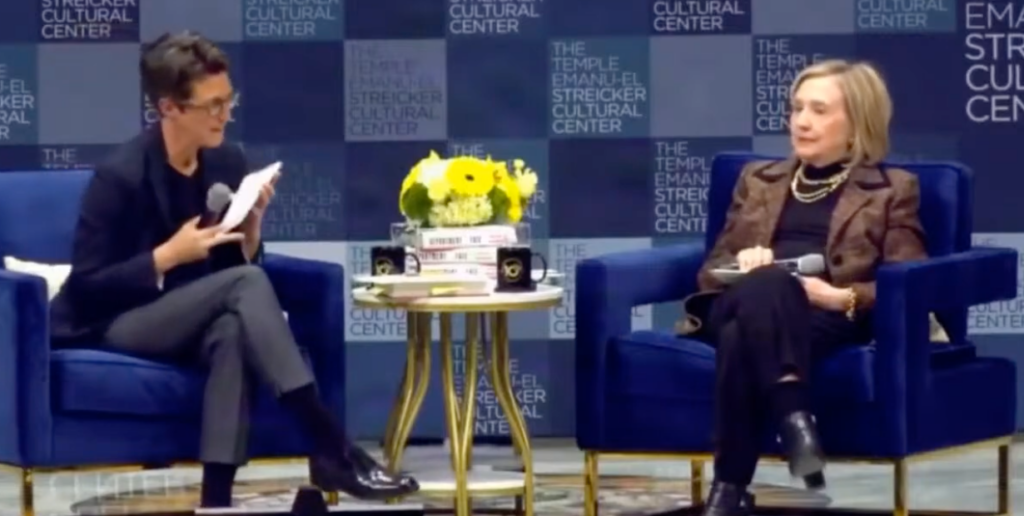
Hillary Clinton thinks WHO is the leader of the free world?! WATCH:
Background info: Former Secretary of State Hillary Clinton has sparked a new political controversy after suggesting that President Donald Trump is no longer the leader of the free world, instead identifying a foreign head of government as a possible replacement. Her remarks, delivered during an interview with television host Rachel Maddow, represent another sharp criticism of Trump’s leadership and America’s changing position on the international stage.
During the conversation, which aired over the weekend of November 14, Clinton was asked whether she believed the free world currently had a recognized leader. Rather than naming the sitting American president, Clinton offered an unexpected response: “Maybe Mark Carney.” The remark referred to Canada’s prime minister, who has repeatedly clashed with Trump over trade policies and the relationship between the neighboring countries.
Maddow appeared receptive to Clinton’s suggestion, arguing that Carney had articulated a vision of democratic nations working together to defend shared values. The exchange quickly attracted attention because the title “leader of the free world” has historically been associated with American presidents, particularly during periods of international confrontation and geopolitical uncertainty.
Clinton’s decision to identify Canada’s prime minister instead of Trump was particularly striking given her background as a former secretary of state, U.S. senator, first lady, and Democratic presidential nominee. Her comments suggested that she believes America’s traditional international leadership has deteriorated significantly during Trump’s second administration, leaving other Western leaders positioned to fill the perceived vacuum.
The former Democratic presidential nominee went considerably further in criticizing Trump’s foreign policy, describing his administration’s approach to international affairs as “dangerous and incoherent.” Clinton accused the president of damaging America’s relationships with longtime allies and pursuing a transactional approach to diplomacy that she believes prioritizes personal relationships and political interests over established international commitments.
Clinton also accused Trump of admiring authoritarian leaders, including Russian President Vladimir Putin and Chinese President Xi Jinping. She suggested that the president views international relations through competing spheres of influence, raising concerns about America’s willingness to defend Ukraine, support European allies, and maintain the broader international order established after World War II.
The remarks came during a conversation at the Temple Emanu-El Streicker Center in New York City, where Clinton joined Maddow to discuss the political landscape following the November midterm elections. Their discussion examined Trump’s presidency, the future of American democracy, and whether a subsequent administration could repair relationships with foreign governments that Clinton believes have been weakened.
Carney, who became Canada’s prime minister in 2025, has emerged as a prominent international critic of Trump’s trade policies. The Canadian leader has opposed American tariffs and defended his country’s sovereignty following Trump’s repeated suggestions that Canada should become the 51st U.S. state.
The disagreement between Washington and Ottawa has created significant tensions between two countries that have historically maintained one of the world’s closest economic and security partnerships. Trade disputes, questions about national sovereignty, and disagreements over international cooperation have contributed to the increasingly contentious relationship.
Before entering Canadian politics, Carney established himself as an influential financial policymaker, serving as governor of both the Bank of Canada and the Bank of England. His experience overseeing major financial institutions helped establish his international reputation before he assumed political leadership in Ottawa.
Clinton’s assessment also reflected her broader concerns about European leadership. Although she acknowledged that several European countries have capable leaders, she argued that the continent has struggled to coordinate its policies effectively, particularly when confronting Russia’s continued military aggression against Ukraine.
She specifically urged European governments to make more decisive use of frozen Russian assets to support Ukraine’s defense. Clinton argued that European nations must demonstrate greater unity and willingness to make difficult decisions if they hope to strengthen their influence in international affairs.
Clinton also warned about the potential consequences of upcoming European elections, particularly in France, where nationalist political movements have challenged traditional political parties. She expressed concern that leaders sympathetic to Putin could weaken European cooperation and complicate efforts to confront Russian aggression.
Her comments represented the continuation of a longstanding political rivalry with Trump, who defeated Clinton in the 2016 presidential election. Since that contest, Clinton has remained one of the president’s most prominent Democratic critics, frequently challenging his approach to international alliances, democratic institutions, and national security.
Interestingly, former President Bill Clinton has also spoken favorably about Carney. During an October campaign appearance, he praised the Canadian prime minister’s qualifications and criticized the Trump administration’s treatment of longstanding American allies, reinforcing the Clintons’ shared concerns about deteriorating international relationships.
Nevertheless, the designation “leader of the free world” is an informal political description rather than an official position. The United States remains a central military, economic, and diplomatic power, and Trump continues to exercise the constitutional authority of the American presidency regardless of Clinton’s assessment of his leadership.
Clinton acknowledged that restoring confidence in American leadership would be difficult even if Democrats regained the White House. She argued that rebuilding international trust would require sustained diplomacy, predictable policies, and a clear explanation of America’s objectives, potentially taking several years to accomplish.
With the 2028 presidential election approaching, Clinton’s comments highlight a fundamental disagreement over America’s role in the world. While Trump has emphasized his America First agenda and a more transactional approach to foreign relationships, Clinton continues to advocate traditional alliances and multilateral cooperation. Her suggestion that Canada’s prime minister could now be the leader of the free world illustrates just how sharply those competing visions have diverged.
Join the Conversation
Keep Reading
Democratic Party Leader Self-Deports
Jennifer Lopez Makes Stunning Hollywood Claim
Gavin Newsom Hit With Major Lawsuit
Trump Issues Chilling Warning to Iran

FBI’s Most Wanted Cartel Leader Captured
Melania Trump Makes Emotional Public Statement
Share your perspective and reply to other readers.
Free account required. You will stay on this page.