
Are We LOSING Texas?
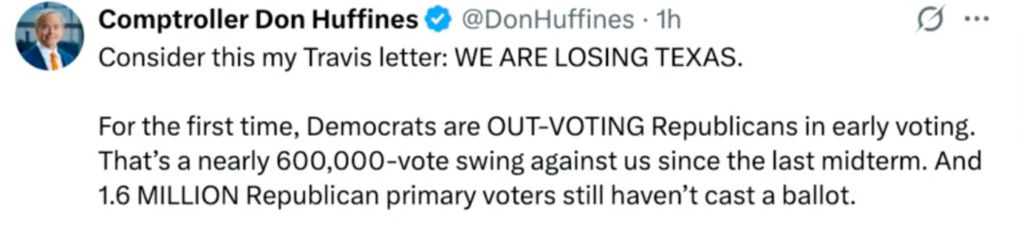
This letter was very concerning… WATCH:
Background Info: Texas is preparing for a consequential midterm election on November 3, 2026, with voters deciding several major contests that could influence the political direction of both the state and the nation. The races for governor, U.S. Senate and the U.S. House of Representatives are attracting particular attention as Republicans seek to maintain their longstanding dominance in Texas while Democrats attempt to make significant gains.
Republicans have controlled Texas statewide politics for decades, but the state’s expanding population, rapidly growing metropolitan areas and changing electorate continue to create opportunities for competitive races. With control of Congress also at stake nationally, both parties are placing considerable importance on voter turnout in major population centers and closely contested congressional districts.
One of the most closely watched statewide contests features Republican Gov. Greg Abbott, who is seeking another four-year term. Abbott faces Democratic state Rep. Gina Hinojosa in a race that could determine the direction of Texas government on issues ranging from immigration enforcement and public education to taxation and economic development.
Abbott enters the contest with significant advantages as an established incumbent who has won multiple statewide elections. His campaign is expected to emphasize border security, economic growth, conservative social policies and his administration’s record of governing one of the country’s largest states.
Hinojosa, meanwhile, is attempting to build a coalition of Democratic voters, independents and Texans dissatisfied with Republican leadership. Her campaign offers voters an alternative on education, health care and other state priorities, although defeating an incumbent Republican governor remains a substantial challenge in Texas.
The governor’s race will also provide an important measure of the state’s political trajectory. Strong Republican turnout in rural communities and smaller cities has historically helped offset Democratic support in major metropolitan areas, making participation in suburban counties especially important.
Another major contest is the race for the U.S. Senate, where Republican Ken Paxton is facing Democrat James Talarico. The election will determine who represents Texas in Washington for the next six years and could have national implications depending on the balance of power in the Senate.
Paxton, the state’s longtime attorney general, has established himself as a prominent conservative figure through legal challenges involving immigration, federal regulations and other national political disputes. His campaign is positioned to appeal to Republican voters who favor an aggressive approach toward the federal government and conservative policymaking.
Talarico, a Democratic state lawmaker, is attempting to broaden his party’s appeal by emphasizing issues affecting working families, public education and government accountability. His challenge will be winning over enough independent and moderate voters while maintaining strong enthusiasm among the Democratic base.
The Senate contest is particularly significant because Republicans have held both of Texas’ U.S. Senate seats for decades. A Democratic victory would represent a major political breakthrough, while a Republican win would preserve the party’s longstanding advantage in statewide federal elections.
Recent polling is an important factor in evaluating these contests, although individual surveys can produce different results depending on their methodology and the voters included. The latest statewide polling margins could not be independently confirmed for this report, making it premature to assign either race a precise projected outcome. Texas’ history of Republican victories provides useful context, but previous election results do not guarantee future performance.
Beyond the statewide contests, elections for Texas’ seats in the U.S. House of Representatives could prove equally important. Every congressional district is holding an election, and even a small number of changes in party control could influence which political party holds the majority in Washington.
Congressional races in the Dallas-Fort Worth region, the Houston metropolitan area, South Texas and other politically competitive communities are receiving particular attention. Campaigns in these areas are expected to focus on the economy, immigration, public safety, federal spending and the performance of the Trump administration.
South Texas remains an especially important region to watch because of changing voting patterns among Hispanic residents. Republicans have made gains in several traditionally Democratic communities in recent election cycles, while Democrats are working to rebuild support and remain competitive in congressional districts along the southern border.
Suburban communities surrounding Dallas, Fort Worth, Houston, Austin and San Antonio could also play a significant role. These areas contain large numbers of voters whose political preferences can shift between elections, potentially affecting both statewide results and individual congressional contests.
Texas voters will also decide several additional statewide offices, including lieutenant governor and attorney general. Republican Lt. Gov. Dan Patrick faces Democrat Vikki Goodwin, while Republican Mayes Middleton and Democrat Nathan Johnson are competing for attorney general following Paxton’s move into the Senate race.
Economic concerns are expected to remain central to the election as Texans evaluate housing costs, property taxes, inflation and employment opportunities. Immigration enforcement and border security will also remain prominent issues, particularly among voters who consider the southern border a major national priority.
With Election Day approaching, the central question is whether Republicans can preserve their commanding position in Texas or whether Democrats can produce meaningful gains in the state’s most important races. The outcomes for governor, U.S. Senate and the U.S. House could help determine not only Texas’ political future but also the balance of power in Washington during the remaining years of President Donald Trump’s term.
Join the Conversation
Keep Reading
Democratic Party Leader Self-Deports

Jennifer Lopez Makes Stunning Hollywood Claim

Gavin Newsom Hit With Major Lawsuit
Trump Issues Chilling Warning to Iran

FBI’s Most Wanted Cartel Leader Captured
Melania Trump Makes Emotional Public Statement

Share your perspective and reply to other readers.
Free account required. You will stay on this page.