Trump Scores Major Win Against Iran
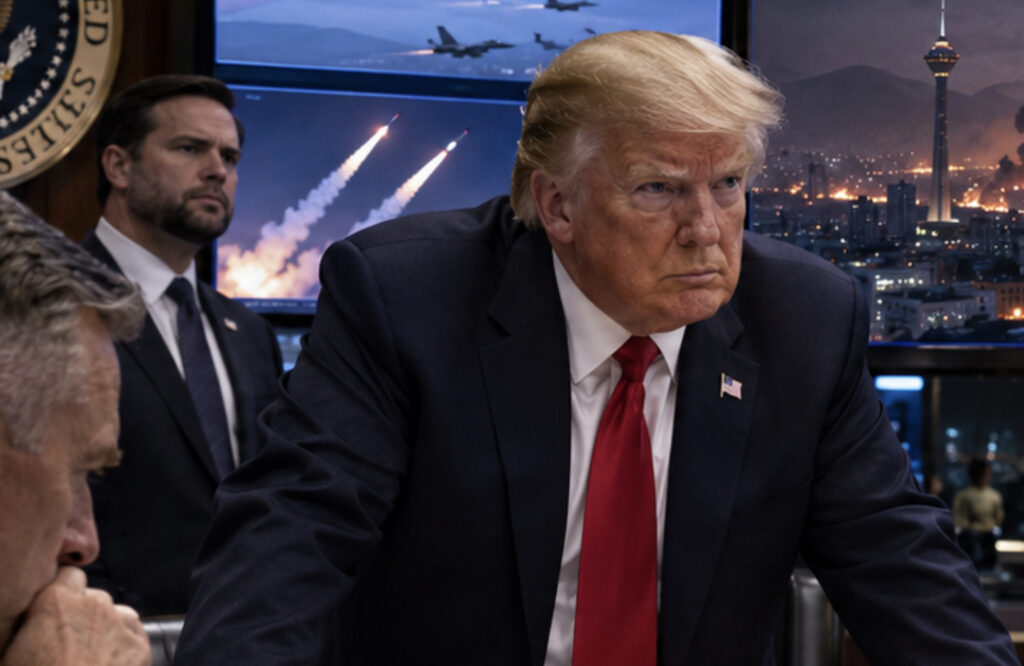
Iranian President Masoud Pezeshkian acknowledged Saturday that the economic battle confronting the Islamic Republic is “far more difficult” than one fought with missiles, as the Trump administration’s campaign to isolate Tehran tightens its grip on the country’s battered economy. The admission comes amid intensified enforcement of a naval blockade, expanded sanctions on oil trade and financial networks, soaring inflation, energy shortages, and fears of renewed anti-regime unrest.
“We are engaged in a silent war that is far more difficult than one in which missiles are launched and destruction is caused,” Pezeshkian told a capital markets conference in Tehran, according to Iran’s state-run IRNA news agency. “It is an economic war, one that you, as economic actors, are dealing with, and it is no easy battle.”
The unusually stark statement laid bare the pressures facing Tehran even as Pezeshkian insisted the country had resisted efforts to cripple it. He also warned that worsening natural gas and electricity shortages threaten factory production and jobs as winter approaches.
Officials have previously prioritized residential electricity supplies out of fear that widespread household outages could provoke public anger. Damage to gas-processing infrastructure has compounded longstanding energy problems, with projections of a domestic gas shortfall of roughly 430 million cubic meters compared with about 300 million previously.
For Tehran, the danger extends beyond lost production and rising prices to the prospect that mounting hardship could reignite demonstrations. Authorities are preparing to deploy a new artificial intelligence-enabled neighborhood monitoring system through the Basij paramilitary force.
The initiative, presented as a neighborhood assistance program, would allow Basij personnel to identify influential residents and map local resources, expanding the organization’s reach into communities already facing economic hardship. The rollout follows reports of renewed anti-regime demonstrations, including a gathering of more than 1,000 protesters in Abdanan earlier in the week.
The growing strain comes as the Trump administration presses its campaign to sever remaining revenue sources. On Friday the Treasury Department imposed new sanctions on Iranian oil intermediaries accused of diverting proceeds from petroleum sales.
Treasury Secretary Scott Bessent said Iran had exhausted the crude oil available aboard vessels outside the American blockade. “The regime has exhausted its seaborne oil supply, and it may never see the revenue from the oil it has already sold,” Bessent said. “The ship is sinking.”
Appearing on Newsmax, Bessent described the isolation effort as “the greatest program in the history of the world to isolate a single country” and declared, “And it is working.” CENTCOM said earlier this month that the blockade alone had prevented more than $25 billion in Iranian crude exports.
Washington is extending the campaign beyond the naval blockade through Task Force Iron Gate, aimed at disrupting illicit shipments and revenue flows through land corridors and the Caspian Sea. Secretary of State Marco Rubio has argued that the economic pressure is so severe that another major round of military strikes is unnecessary for now.
“The economic pain that is being inflicted on Iran right now and on that regime is extraordinary and it compounds,” Rubio said. “There’s no need to disrupt that at this point.”
Diplomatic sources have indicated that President Trump favors intensifying the economic campaign over launching another broad military offensive. The effort includes pressing regional governments to shut down routes used to disguise Iranian oil shipments.
Dwindling oil revenue, mounting energy shortages, and growing fears of unrest leave Iran’s leadership facing consequences that Pezeshkian himself describes as more difficult than conventional conflict.
The combination of naval interdiction and targeted financial sanctions has reduced the regime’s ability to convert remaining oil stocks into usable revenue.
Energy shortfalls threaten both industrial output and household supplies heading into winter.
Preparations for expanded domestic surveillance reflect official concern that economic hardship could translate into public disorder.
U.S. officials continue to emphasize sustained economic pressure as the preferred tool for compelling policy changes in Tehran.
Join the Conversation
Keep Reading

AOC’s Luxury Spending EXPOSED
Melania Trump Makes Emotional Public Statement
AOC’s Luxury Spending EXPOSED
Bombshell Report on Somali Democrat Married To Illegal Immigrant
Trump Responds to Elon Musk’s Anti-MAGA Remark
Legendary Singer Faces Criminal Investigation

Share your perspective and reply to other readers.
Free account required. You will stay on this page.